How to Hire Ukrainian Developers in 2026: Costs, Process & Guide

Introduction: Why Ukraine Still Tops the List in 2026
Here's a number most people don't expect: Ukraine's IT sector has consistently exported over $7 billion in services annually in recent years, making it one of Europe's largest tech export economies — during an active war. That figure tells you everything you need to know about the resilience, professionalism, and raw capability of Ukrainian developers.
Despite everything — blackouts, air raid disruptions, internal displacement — Ukrainian tech workers kept shipping. Companies worldwide noticed. In 2026, hiring Ukrainian developers isn't an act of charity or a cost-arbitrage play. It's a strategic talent decision driven by one of the deepest, most battle-tested engineering talent pools on the planet.
This guide covers what you actually need to know: the talent landscape, realistic costs, legal and logistical details, and how to navigate the hiring process without getting burned. Whether you're a startup building your first remote team or an established company extending your engineering org, here's the playbook.
The Ukrainian Tech Talent Pool: What You're Actually Getting
Education and Technical Depth
Ukraine's engineering pipeline runs deep. The country graduates roughly 30,000 IT specialists annually from universities with strong STEM traditions — Kyiv Polytechnic Institute, Lviv Polytechnic, and KPI-affiliated programs are recognized across Europe for producing engineers with serious mathematical and systems-level foundations.
Unlike many markets where "computer science" curricula lag behind industry practice, Ukrainian CS programs tend to emphasize practical problem-solving, algorithms, and low-level systems thinking. That's why you'll find Ukrainian developers disproportionately represented in complex domains: distributed systems, fintech infrastructure, cybersecurity, and embedded systems.
Dominant Tech Stacks
The talent distribution in 2026 looks roughly like this:
- Frontend: React, Vue.js, Next.js, TypeScript — Ukraine has one of the strongest frontend communities in Eastern Europe
- Backend: Node.js, Python, Java, .NET, Go — deep benches across all major enterprise and startup stacks
- Mobile: Swift, Kotlin, React Native, Flutter
- DevOps & Cloud: AWS, GCP, Azure, Kubernetes, Terraform — infrastructure engineering is a particular strength
- Emerging: AI/ML engineering is growing fast, with a cluster of specialists in Kyiv and Lviv
English Proficiency
Most mid-to-senior Ukrainian developers speak English at a B2 or higher level. English has been the working language in Ukrainian IT for over a decade — it's not an afterthought, it's the default. You should expect clear written communication and solid conversational English from any developer with 3+ years of professional experience.
The Resilience Factor
This deserves its own mention. Ukrainian developers have spent years navigating real adversity — power grid attacks, forced relocations, disrupted infrastructure — and they've built workflows that are remarkably resilient. Async communication, backup internet setups, generator-powered offices, distributed team structures: these aren't theoretical practices. They're lived experience.
What does that mean for you as a hiring manager? You get engineers who are resourceful, self-directed, and unflappable under pressure. The kind of people who figure it out, whatever "it" is.
Cost vs. Quality: What to Budget
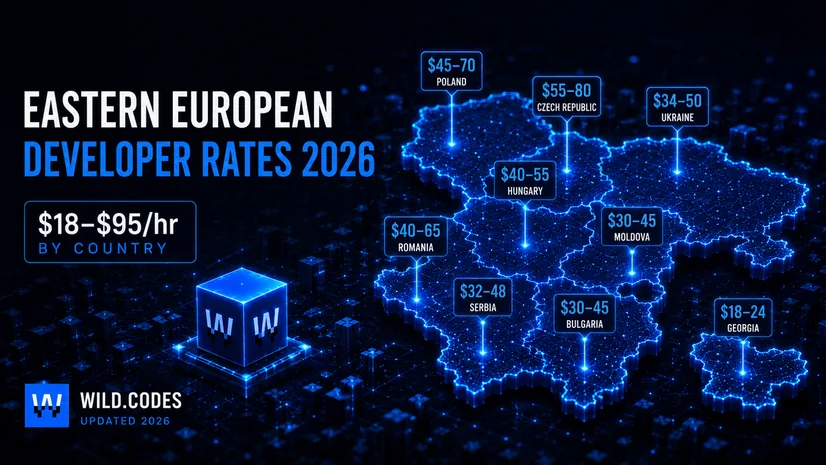
Let's get specific. Here are realistic monthly rates for Ukrainian developers in 2026 (full-time, B2B contract):
| Seniority | Monthly Range (USD) | Typical Role |
|---|---|---|
| Junior (1–2 years) | $2,000–$3,500 | Feature implementation, bug fixes, testing |
| Mid-level (3–5 years) | $3,500–$5,500 | Feature ownership, system design contribution |
| Senior (5–8 years) | $5,500–$8,000 | Architecture, tech leadership, mentoring |
| Lead/Staff (8+ years) | $8,000–$12,000 | CTO-as-a-service, system-level design |
These rates are 40–60% lower than equivalent talent in Western Europe or the US, with no meaningful drop in code quality. That's not an exaggeration — Ukrainian senior developers regularly pass the same technical bars as their Western European counterparts, often with stronger fundamentals.
The ROI math is straightforward: hire one senior Ukrainian developer at $6,500/month instead of a US-based senior at $15,000–$20,000/month, and you've freed up enough budget to hire two mid-level developers and a QA engineer. Same capability, triple the output.
What's NOT included in those rates
- Platform fees (if using a hiring platform like Wild.Codes, Lemon.io, or others)
- Employer-side taxes and compliance (varies by engagement model)
- Equipment costs (most Ukrainian developers have their own setups, but some companies provide additional hardware)
Engagement Models: How to Actually Hire
There are three main paths:
1. Direct Hire (B2B Contract)
You contract directly with the developer as an individual entrepreneur (FOP in Ukraine — "Фізична особа-підприємець"). This is the most common model and the one most Ukrainian developers prefer.
Pros: Lowest cost, direct relationship, maximum flexibility.
Cons: You handle compliance, payments, and contracts yourself. You'll need to understand Ukrainian B2B invoicing, or use a payment processor like Deel, Remote, or Wise.
2. Through a Hiring Platform
Platforms like Wild.Codes handle the sourcing, vetting, matching, and often the compliance and payroll layer. You describe what you need, they match you with pre-vetted candidates, and you interview and decide.
Pros: Fast, low-risk, handles compliance and payroll. Typically includes trial periods and replacement guarantees.
Cons: Slightly higher monthly cost than direct hire (the platform margin). Less control over the exact sourcing process.
3. Through an Outsourcing Agency
A dev shop or staff augmentation agency provides developers as part of a managed service.
Pros: They handle everything — hiring, HR, infrastructure, management overhead.
Cons: Most expensive option, least direct relationship with the developer, often less flexible on scaling up or down.
Our recommendation for startups: The platform route (option 2) hits the sweet spot. You get pre-vetted talent without the enterprise overhead, and someone else handles the paperwork. More on this below.
Legal and Logistical Considerations
Contracts and Taxes
Most Ukrainian developers operate as sole proprietors (FOP) under a simplified tax regime. For you as the hiring company, this means:
- You issue a B2B services contract, not an employment contract
- The developer invoices you monthly
- No employer-side social contributions are required from your end (the developer handles their own Ukrainian taxes)
- This is clean, legal, and standard practice
If your company requires an employer-of-record setup, services like Deel, Remote, or Oyster can handle Ukrainian payroll compliance.
Timezone Advantage
Ukraine sits at GMT+2 (GMT+3 during summer). For European companies, that's the same workday. For US East Coast teams, there's a 7-hour overlap — enough for a solid synchronous window plus async deep work. For US West Coast, the overlap shrinks to 4–5 hours, but that's still very manageable with async-first practices.
IP Protection
Ukraine is a signatory to major international IP treaties. Standard IP assignment clauses in B2B contracts are enforceable. Include a clear IP assignment clause in your contract (most platforms include this by default), and you're covered.
Data Security
Ukrainian IT companies and developers are well-versed in data security compliance. Most senior developers have experience working under SOC 2, GDPR, and HIPAA requirements. If you're in a regulated industry, specify your requirements upfront — it's routine.
Step-by-Step: The Hiring Process
Step 1: Define Your Need
Be specific. "A React developer" isn't enough. Write down:
- Tech stack (exact frameworks, libraries, databases)
- Seniority level (and what that means in your context)
- Project type (greenfield, maintenance, migration, scaling)
- Team setup (solo, embedded in your team, or leading a pod)
- Budget range (monthly, all-in)
- Start timeline
Step 2: Choose Your Hiring Channel
Based on the engagement models above:
- Direct sourcing: Post on LinkedIn, DOU.ua (the largest Ukrainian tech job board), or Djinni.co (popular in Ukraine and Eastern Europe)
- Platform route: Submit a brief to Wild.Codes or similar — they'll match you with pre-vetted candidates
- Agency route: Reach out to established outsourcing firms
For speed and quality, the platform route is hard to beat. Wild.Codes, for example, typically delivers the first qualified candidate introduction in under a week — and every candidate has already passed a multi-stage vetting process.
Step 3: Interview and Evaluate
A solid interview process for a Ukrainian developer is the same as for any strong engineer:
- Technical screen (45–60 min) — live coding or system design, focused on real-world problems
- Code review or take-home — give them a realistic task from your codebase
- Culture and communication (30 min) — assess English fluency, collaboration style, timezone overlap
Pro tip: Don't over-index on accent. Focus on clarity of thought, written communication quality, and the ability to explain complex technical decisions. Those matter far more than accent-free speech.
Step 4: Onboard and Integrate
Ukrainian developers are used to remote-first work. But a structured onboarding still matters:
- Provide clear documentation for your codebase, architecture, and processes
- Set up communication channels (Slack, Discord, etc.) and define async norms
- Schedule regular 1:1s and team syncs in the overlap window
- Give them a real first task — not a throwaway — to build confidence and momentum
The Wild.Codes Advantage: Hiring Ukrainian Developers, Simplified
If the logistics above sound like a lot to manage, that's because they can be. Wild.Codes was built specifically to remove that friction — particularly for startups that want access to Ukrainian (and broader Eastern European) talent without becoming experts in international contractor compliance.
Here's how it works:
1. You submit a hiring brief. Stack, seniority, project context, budget, timeline.
2. Wild.Codes matches you with 2–5 pre-vetted candidates. Every developer in the network has passed a multi-stage screening process — technical assessment, practical coding test in their primary stack, and a structured soft-skills interview. Acceptance rate: under 8%.
3. You interview your top picks. Standard technical + cultural fit interviews, on your terms.
4. Wild.Codes handles the rest. Contracts, compliance, payroll, taxes, PTO — all covered. No 1099s, no international wire headaches, no legal guesswork.
5. 1-week paid trial. Work with your chosen developer for a week. Cameras on, real tasks, real integration. If they're not the right fit, Wild.Codes replaces them at no cost.
What this costs: Transparent monthly pricing with no recruitment fees, no upfront deposits, and no binding long-term contracts. You can scale up or down with 30 days' notice.
The result: you get the quality and cost advantage of hiring Ukrainian developers, without any of the administrative overhead. You focus on building product; Wild.Codes handles the rest.
→ Start hiring with Wild.Codes
Frequently Asked Questions
"Is it safe to hire in Ukraine right now?"
Yes. The vast majority of Ukrainian developers work remotely and have established resilient workflows (backup power, internet redundancy, distributed locations). Business continuity is a solved problem in Ukrainian tech. That said, discuss risk mitigation with your hiring platform or the developer directly.
"Will they really be as good as local developers?"
In many cases, better. Ukrainian CS education is rigorous, the developer community is tightly networked and knowledge-sharing, and the practical experience of shipping under adverse conditions builds a kind of engineering maturity that's hard to replicate. Many Ukrainian developers contribute to major open-source projects and speak at international conferences.
"What about cultural fit?"
Ukrainian work culture tends to be direct, pragmatic, and delivery-oriented. There's less corporate theater, more focus on solving the actual problem. For startup teams especially, this is a feature, not a bug. If you value shipping over process, you'll find strong cultural alignment.
"How do I handle payments?"
Three options:
- B2B invoice — the developer invoices you monthly; you pay via wire transfer, Wise, or similar
- Employer of record (Deel, Remote, etc.) — they handle payroll and compliance for a fee
- Through a platform (Wild.Codes) — payments are bundled into the monthly fee; you pay one invoice, they handle everything downstream
Conclusion
Ukraine remains one of the smartest places to hire developers in 2026. The talent pool is deep, the cost-to-quality ratio is exceptional, and the logistics are more streamlined than most people assume.
The key is choosing the right hiring channel for your situation. If you're a startup that wants pre-vetted talent, fast matching, and zero administrative overhead, Wild.Codes was built exactly for this.
Ready to find your next great developer? Submit a hiring brief →
Further Reading
- Toptal vs Wild.Codes: Which is Better for Startups?
- How to Hire Remote Developers
- What Is a Remote Developer Hiring Platform?
- About Wild.Codes
Article by Wild.Codes — helping startups hire pre-vetted remote developers, fast.

• PHP expertise;
• Database management skills;
•Jungling traits, methods, objects, and classes;
• Agile & Waterfall understanding and use;
• Soft skills (a good team player, high-level communication, excellent problem-solving background, and many more)
• OOP & MVS deep understanding;
• Knowledge of the mechanism of how to manage project frameworks;
• Understanding of the business logic the project meets;
• Cloud computing & APIs expertise.
• Reasonable life-work balance;
• The opportunity to implement the server-side logic via Laravel algorithms;
• Hassle-free interaction with back-end and front-end devs;
• Strong debugging profile.
• Using HTML, XHTML, SGML, and similar markup languages
• Improving the usability of the digital product
• Prototyping & collaboration with back-end JS experts
• Delivery of high-standard graphics and graphic-related solutions
• Using JS frameworks (AngularJS, VueJS, ReactJS, etc
• Clean coding delivery and timely debugging & troubleshooting solution delivery
• UI testing and collaboration with front-end JS teammates
• Database experience
• Building APIs while using REST or similar tech solutions
• Collaboration with project managers and other devs
• Delivery of design architecture solutions
• Creation of designs & databases
• Implementation of data protection and web cybersecurity strategies.
• Both front-end and back-end qualifications