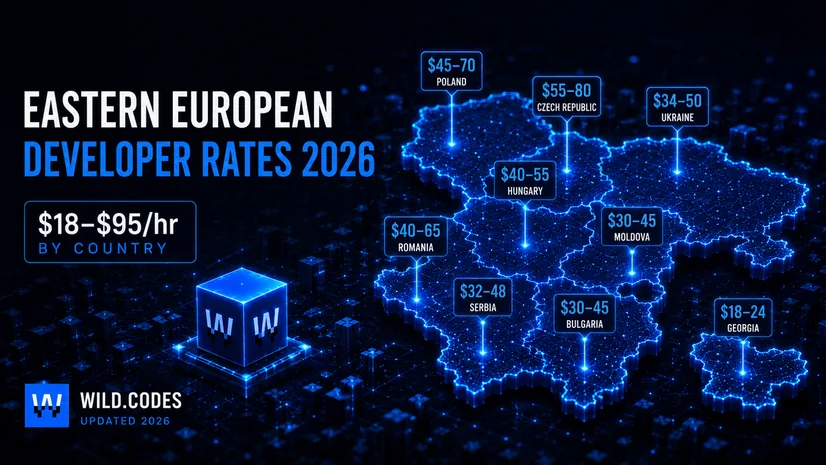
Eastern European Developer Rates 2026: $18–$95/hr by Country

Why Eastern Europe, Still
If you're still budgeting off 2023 numbers, you're either overpaying or about to get a rude surprise from a recruiter. Rates in Eastern Europe shifted in 2025–2026: the post-pandemic hiring rush cooled, senior contractor rates flattened or dipped slightly in a few markets, and AI/ML specialists pulled the top of the range sharply upward. This guide breaks down what developers actually cost today, country by country, so you can build your budget on real numbers instead of a two-year-old blog post (including our own).
The pitch hasn't changed much because it still holds up:
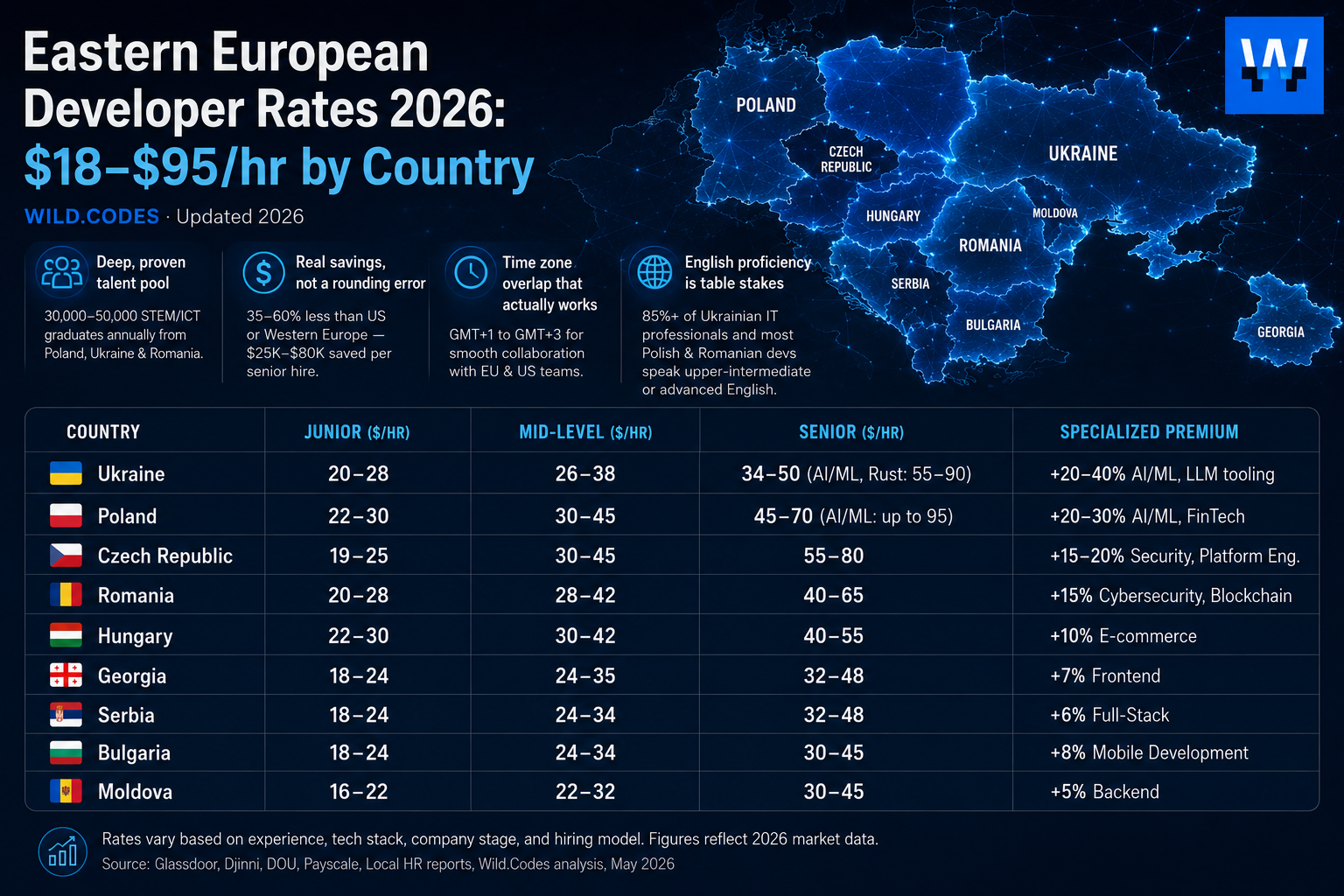
- Deep, proven talent pool. Poland, Ukraine, and Romania alone graduate 30,000–50,000 STEM/ICT students a year, and developers from the region routinely place at the top of global coding assessments. Decades of a math-and-engineering-first education tradition show up in how these teams approach architecture, not just syntax.
- Real savings, not a rounding error. Senior engineers in the region typically cost 35–60% less than equivalent US or Western European hires — often $25,000–$80,000 in annual savings per seat, depending on role and specialization.
- Time zone overlap that actually works. Eastern Europe sits at GMT+1 to GMT+3, giving European teams a full working day of overlap and US teams a solid morning window for stand-ups and reviews.
- English proficiency is no longer a caveat. Over 85% of Ukrainian IT professionals and the majority of Polish and Romanian developers operate at upper-intermediate or advanced English — this stopped being a differentiator and became table stakes.
What's changed since 2025: rates compressed at the senior tier as the 2022–23 hiring rush cooled off, while AI, ML, and LLM-tooling specialists broke away from the pack entirely, commanding 20–40% premiums over generalist senior rates almost everywhere in the region.
Hourly Rates Across Eastern Europe in 2026
Here's the country-by-country breakdown — junior, mid-level, and senior hourly rates, plus where specialization moves the number:
| Country | Junior ($/hr) | Mid-Level ($/hr) | Senior ($/hr) | Specialized Premium |
|---|---|---|---|---|
| Ukraine | 20–28 | 26–38 | 34–50 (AI/ML, Rust: 55–90) | +20–40% AI/ML, LLM tooling |
| Poland | 22–30 | 30–45 | 45–70 (AI/ML: up to 95) | +20–30% AI/ML, FinTech |
| Czech Republic | 19–25 | 30–45 | 55–80 | +15–20% Security, Platform Eng. |
| Romania | 20–28 | 28–42 | 40–65 | +15% Cybersecurity, Blockchain |
| Hungary | 22–30 | 30–42 | 40–55 | +10% E-commerce |
| Georgia | 18–24 | 24–35 | 32–48 | +7% Frontend |
| Serbia | 18–24 | 24–34 | 32–48 | +6% Full-Stack |
| Bulgaria | 18–24 | 24–34 | 30–45 | +8% Mobile Development |
| Moldova | 16–22 | 22–32 | 30–45 | +5% Backend |
A few things worth calling out:
- Czech Republic quietly overtook Poland at the senior end. Senior backend, security, and platform engineering rates in Prague climbed past Polish levels in 2024–2025, driven by a tight local supply and strong demand from EU clients wanting full compliance coverage.
- Ukraine remains the deepest senior bench in the region, with thousands of active contract data points across 40+ tech stacks — and it continues to price slightly below Poland and Romania for comparable seniority.
- Bulgaria and Moldova are the value plays, not the compromise plays. The quality bar hasn't dropped — the cost of living has just stayed lower, and that shows up directly in the rate.
Monthly Salaries in Major Tech Hubs (Full-Time Hires)
If you're hiring full-time rather than contracting hourly, here's what that looks like across the region's main tech hubs:
| City | Junior ($) | Mid-Level ($) | Senior ($) |
|---|---|---|---|
| Kyiv, Ukraine | 2,200 | 4,000 | 6,500 |
| Warsaw, Poland | 2,800 | 5,200 | 8,000 |
| Prague, Czech Republic | 3,200 | 5,800 | 9,000 |
| Bucharest, Romania | 2,500 | 4,500 | 7,200 |
| Budapest, Hungary | 2,800 | 4,800 | 7,200 |
| Tbilisi, Georgia | 2,200 | 3,800 | 6,000 |
| Belgrade, Serbia | 2,000 | 3,600 | 5,800 |
| Sofia, Bulgaria | 2,000 | 3,600 | 5,800 |
| Chisinau, Moldova | 1,800 | 3,200 | 5,200 |
Keep in mind: the sticker salary is only part of the real cost. Add 25–35% for payroll taxes, benefits, and employer overhead if you're hiring direct — or fold all of that into a flat monthly rate if you're going through a subscription or EOR model instead.
What Actually Moves the Price
- Specialization, not seniority alone. In 2026, the biggest single rate jump isn't junior-to-mid or mid-to-senior — it's generalist-to-specialist. A senior backend developer and a senior LLM/MLOps engineer can carry the same "senior" title and a 60–80% difference in rate.
- Country and city. Prague, Warsaw, and Kyiv set the ceiling for their countries; smaller cities and remote-first hires typically run 10–20% below capital-city rates.
- Engagement type. Freelance/contract (B2B) rates run higher per hour than full-time employment, but full-time carries payroll, benefits, and compliance overhead on top of the base number.
- Contract structure. Most senior developers in the region are hired B2B (the developer invoices through a personal company) rather than as direct employees — this changes both the effective hourly rate and who's responsible for tax and compliance.
- Project complexity and urgency. Complex, high-stakes, or fast-turnaround projects command a premium regardless of country.
Eastern Europe vs. Other Regions in 2026
| Region | Average Hourly Rate ($) | Cultural Compatibility | Time Zone Advantage | Talent Pool Size |
|---|---|---|---|---|
| Eastern Europe | 18–95 | High | Excellent (EU/US overlap) | Deep and growing |
| Western Europe | 40–150 | Very High | Excellent | Moderate |
| North America | 55–150 | Very High | Limited for EU teams | Large |
| Latin America | 13–61 | High | Strong for US teams | Growing |
| South Asia | 12–50 | Medium | Moderate | Very Large |
The honest read: Eastern Europe and Latin America are the two regions actually competing for the "best cost-to-quality ratio with real time-zone overlap" spot in 2026. Eastern Europe wins on European overlap and specialist depth (especially AI/ML); Latin America wins if your team is US-based and needs same-day, real-time collaboration.
Rates by Technology and Specialization
Specialization premiums widened in 2025–2026 as AI and LLM work pulled away from commodity development. Here's where the money actually is:
| Technology / Specialization | Average Hourly Rate ($) | Strongest Country Match |
|---|---|---|
| AI / ML / LLM Engineering | 50–110 | Poland, Ukraine |
| Cloud & DevOps | 45–85 | Poland, Ukraine, Czech Republic |
| Cybersecurity | 45–80 | Czech Republic, Romania |
| Blockchain / Web3 | 45–75 | Ukraine, Romania |
| Mobile Development (iOS/Android) | 30–65 | Bulgaria, Romania, Poland |
| E-commerce Solutions | 40–70 | Hungary, Serbia |
Two patterns matter more than the numbers themselves: first, a senior generalist and a senior specialist can carry an identical job title and still be 40–80% apart on rate — the premium is about what the engineer owns end-to-end, not years of experience. Second, if you're hiring for AI/ML work in 2026, treat "senior" as a starting filter, not a guarantee — ask for LLM tooling, MLOps, or production RAG experience specifically, because the generalist-to-specialist gap is where budgets quietly blow past estimates.
How the Main Hiring Platforms Compare
| Platform | Pricing Model | Time to Shortlist | Compliance & Payroll | What It's Actually Good At |
|---|---|---|---|---|
| Wild.Codes | Flat monthly subscription per developer | 47 hours | Included (contracts, payroll, compliance) | Fast, pre-vetted shortlists with a 1-week trial and free replacement guarantee — built for startups that can't afford a bad hire or a 6-week wait. |
| Lemon.io | Hourly, freelance-first | 24–48 hours | Limited | Fast matching for smaller projects and tight budgets; less suited for long-term team scaling. |
| Toptal | Premium hourly / retainer | 1–3 weeks | Yes | Rigorous "top 3%" vetting, but priced and paced for larger budgets. |
| YouTeam | Staff augmentation | 1–2 weeks | Yes | Pre-vetted Eastern European teams for longer-term dedicated engagements. |
| DevsData | Recruiter-assisted | 2–3 weeks | Yes | Senior and enterprise-focused searches, slower by design. |
| Open freelance marketplaces (Upwork, etc.) | Variable | Varies | No | Cheapest entry point, but quality and reliability vary from developer to developer. |
The pattern across the market: speed and quality of vetting tend to trade off against price and against how much compliance work gets handled for you. Subscription models like Wild.Codes exist specifically to close that gap — flat pricing with no per-hire agency markup, payroll and contracts handled, and a shortlist fast enough that it doesn't stall your roadmap while you wait.
Cost-Saving Moves Worth Actually Using
- Go nearshore inside the region when you don't need a specific country. Moldova, Georgia, and Serbia offer the same engineering rigor at 20–30% below Poland or Czech rates — the trade-off is smaller talent pools, not weaker developers.
- Separate "senior" from "specialist" in your budget from day one. If the role needs AI/ML, security, or platform depth, price it as a specialist role — treating it as a standard senior hire is how teams end up renegotiating mid-search.
- Use a trial period before committing long-term. A one-week paid trial catches culture and communication mismatches that a resume and two interviews never will.
- Match engagement type to project length. Freelance/contract rates are higher per hour but carry no long-term obligation; full-time or subscription-based hiring costs less per hour but assumes a longer runway.
Frequently Asked Questions
Are Eastern European developer rates still rising in 2026?
Not uniformly. Senior rates flattened or dipped slightly in several markets after the 2022–23 hiring rush cooled off. The clear exception is AI/ML and LLM-tooling specialists, whose rates kept climbing through 2025–2026 as demand outpaced supply.
Which Eastern European country offers the best value in 2026?
Ukraine still has the deepest senior talent bench in the region at competitive rates. For EU-jurisdiction requirements, Poland and Romania are the strongest alternatives, though at somewhat higher cost. Moldova, Georgia, and Serbia are the budget-conscious picks without a real drop in engineering quality.
Should I hire full-time or contract (B2B)?
Contract/B2B is the regional default for senior developers and gives you flexibility without long-term obligation. Full-time makes more sense once you know a role is permanent and you want deeper long-term integration — though it adds payroll, benefits, and compliance overhead that a subscription model like Wild.Codes handles for you.
How fast can I actually hire?
Traditional recruiters average 35–50+ days in the EU and can stretch to 3–6 months for senior or specialized roles. Vetted-marketplace and subscription models compress that to days — Wild.Codes delivers a shortlist in 47 hours.
Ready to Hire Eastern European Developers?
Stop comparing rate tables and start building your team. Wild.Codes connects you with AI-vetted developers from Eastern Europe — matched in under 47 hours, with a flat subscription rate, payroll and compliance handled, and a free replacement guarantee if the fit isn't right.
- Hire Eastern European Developers → — Browse pre-vetted talent from Ukraine, Poland, Romania, and 6 more countries
- Hire React Developers → — Senior React engineers, available in under 48 hours
- Hire Python Developers → — Full-stack and AI/ML Python talent across the region
- Hire Full-Stack Developers → — Versatile engineers for end-to-end product delivery
- Use the Team Cost Calculator → — Get an instant estimate for your team composition
Conclusion
Eastern Europe still offers one of the strongest cost-to-quality ratios in global tech hiring in 2026 — but the numbers have shifted enough since 2025 that budgeting off last year's rates is a real risk, especially if you're hiring for AI/ML or security roles. Whether you need one specialist or a full team, the fastest way to turn this data into an actual hire is a platform that's already done the vetting. That's exactly what Wild.Codes is built for.

• PHP expertise;
• Database management skills;
•Jungling traits, methods, objects, and classes;
• Agile & Waterfall understanding and use;
• Soft skills (a good team player, high-level communication, excellent problem-solving background, and many more)
• OOP & MVS deep understanding;
• Knowledge of the mechanism of how to manage project frameworks;
• Understanding of the business logic the project meets;
• Cloud computing & APIs expertise.
• Reasonable life-work balance;
• The opportunity to implement the server-side logic via Laravel algorithms;
• Hassle-free interaction with back-end and front-end devs;
• Strong debugging profile.
• Using HTML, XHTML, SGML, and similar markup languages
• Improving the usability of the digital product
• Prototyping & collaboration with back-end JS experts
• Delivery of high-standard graphics and graphic-related solutions
• Using JS frameworks (AngularJS, VueJS, ReactJS, etc
• Clean coding delivery and timely debugging & troubleshooting solution delivery
• UI testing and collaboration with front-end JS teammates
• Database experience
• Building APIs while using REST or similar tech solutions
• Collaboration with project managers and other devs
• Delivery of design architecture solutions
• Creation of designs & databases
• Implementation of data protection and web cybersecurity strategies.
• Both front-end and back-end qualifications