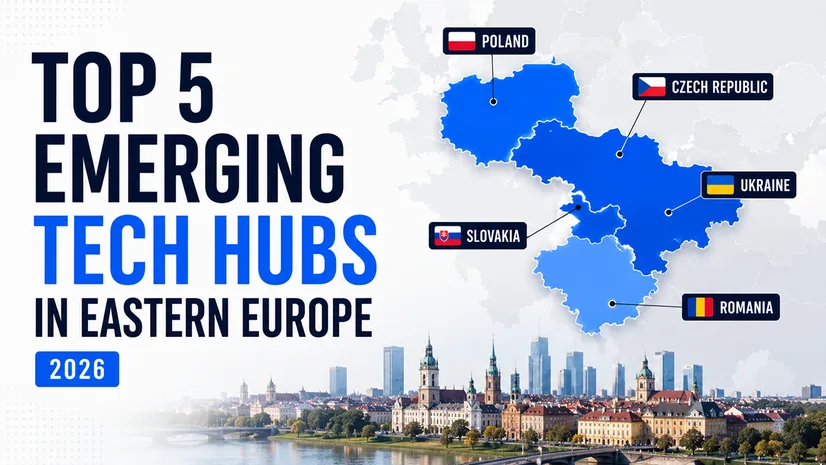
Top 5 Emerging Tech Hubs in Eastern Europe (2026 Guide)

Eastern European developers remain the default answer for teams that want convenient time-zone overlap, sharp technical skills, and rates that don't wreck a startup budget. What earns them repeat business, though, is less about price and more about how they work: remote-first by default, self-directed, and comfortable in English at a level that makes daily stand-ups painless. Here's an updated look at the top 5 tech hubs in Eastern Europe for 2026.
1. Ukraine
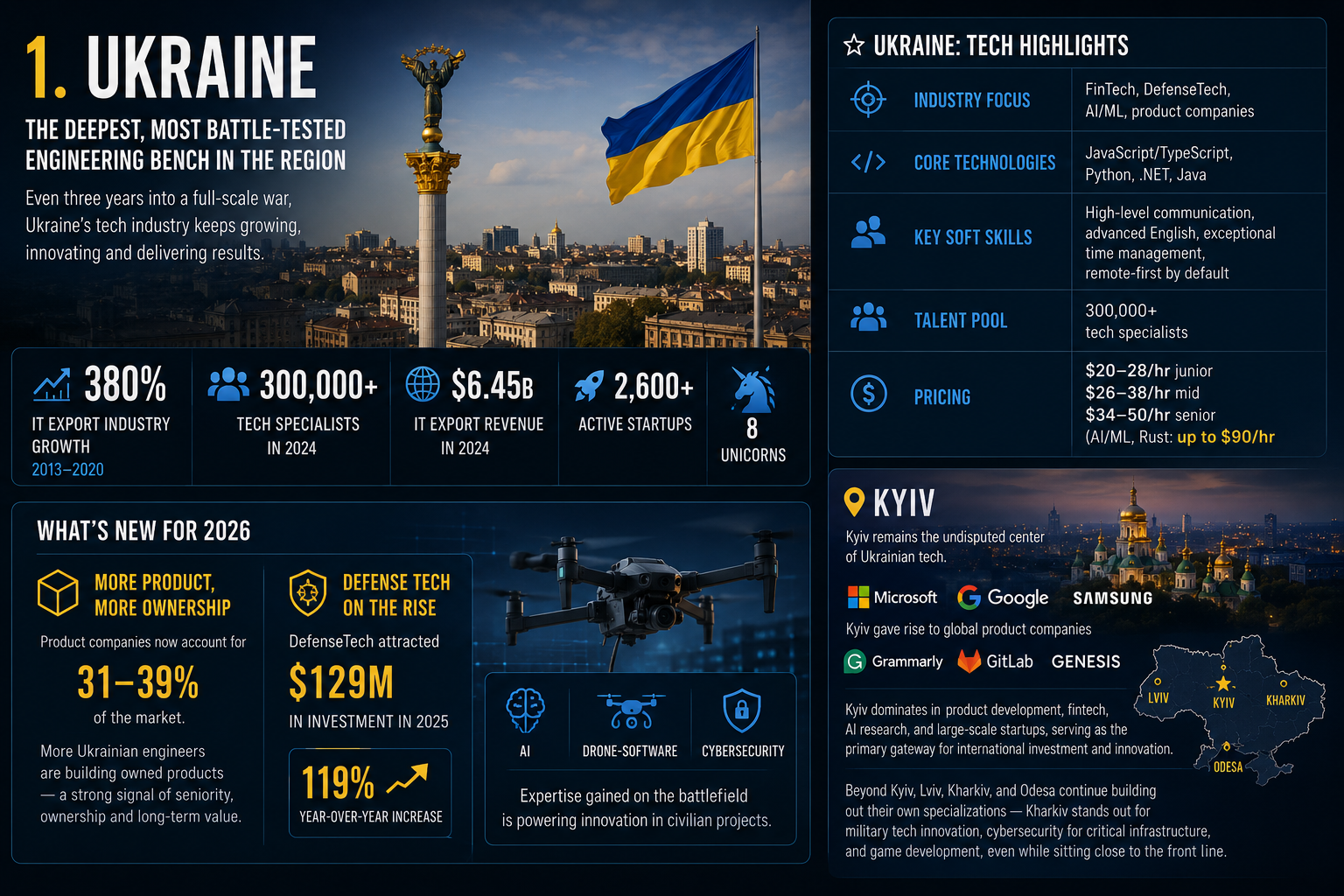
Ukraine is still the deepest, most battle-tested engineering bench in the region — and the data backs that up even three years into a full-scale war. Ukraine's IT export industry grew 380% between 2013 and 2020, and that trajectory hasn't reversed: the tech workforce surpassed 300,000 specialists in 2024, with $6.45 billion in IT export revenue that year, and the country now counts over 2,600 active startups and 8 unicorns.
What's genuinely new for 2026 is the shift in what Ukrainian teams are building. Product companies now account for 31–39% of the market, meaning more Ukrainian engineers are shipping owned products rather than servicing outsourced contracts — a meaningful signal about the seniority and ownership you can expect from a Ukrainian hire. The other story is defense tech: DefenseTech attracted $129 million in investment in 2025, a 119% year-over-year increase, and that's translating directly into AI, drone-software, and cybersecurity expertise available for civilian projects too.
Ukraine: Tech Highlights
| Industry focus | FinTech, DefenseTech, AI/ML, product companies |
|---|---|
| Core technologies | JavaScript/TypeScript, Python, .NET, Java |
| Key soft skills | High-level communication, advanced English, exceptional time management, remote-first by default |
| Talent pool | 300,000+ tech specialists |
| Pricing | $20–28/hr junior · $26–38/hr mid · $34–50/hr senior (AI/ML, Rust: up to $90/hr) |
Kyiv
Kyiv remains the undisputed center of Ukrainian tech. Microsoft, Google, and Samsung all keep local offices here, and the city gave rise to Grammarly, GitLab, and Genesis. Kyiv dominates in product development, fintech, AI research, and large-scale startups, serving as the primary gateway for international investment and innovation. Beyond Kyiv, Lviv, Kharkiv, and Odesa continue building out their own specializations — Kharkiv in particular is notable for military tech innovation, cybersecurity for critical infrastructure, and game development, even while sitting close to the front line.
2. Poland
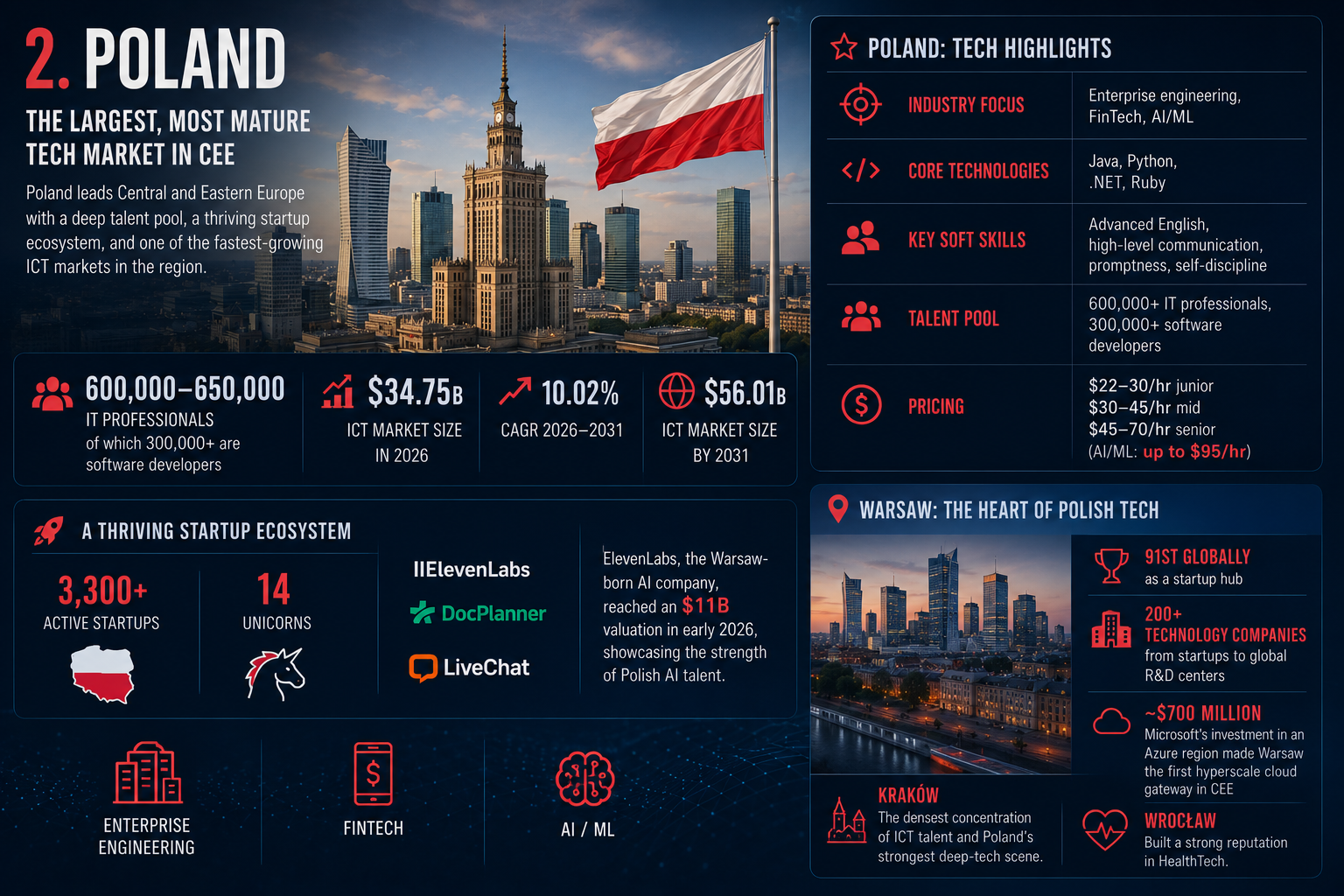
Poland has extended its lead as the largest, most mature tech market in Central and Eastern Europe. The broad estimate for IT professionals sits at roughly 600,000–650,000, of which 300,000-plus are concentrated software developers across six major hubs — Warsaw, Kraków, Wrocław, Gdańsk, Poznań, and Łódź. On the market side, Poland's ICT market is worth $34.75 billion in 2026 and is growing at a 10.02% CAGR toward $56.01 billion by 2031.
The startup engine keeps running too: Poland now has over 3,300 active startups, and the country counts 14 unicorns, including ElevenLabs, DocPlanner, and LiveChat. ElevenLabs in particular is a useful data point for 2026 — the Warsaw-born AI company reached an $11 billion valuation in early 2026, underlining how far Polish AI talent has come from its "outsourcing hub" reputation of a decade ago.
Poland: Tech Highlights
| Industry focus | Enterprise engineering, FinTech, AI/ML |
|---|---|
| Core technologies | Java, Python, .NET, Ruby |
| Key soft skills | Advanced English, high-level communication, promptness, self-discipline |
| Talent pool | 600,000+ IT professionals, 300,000+ software developers |
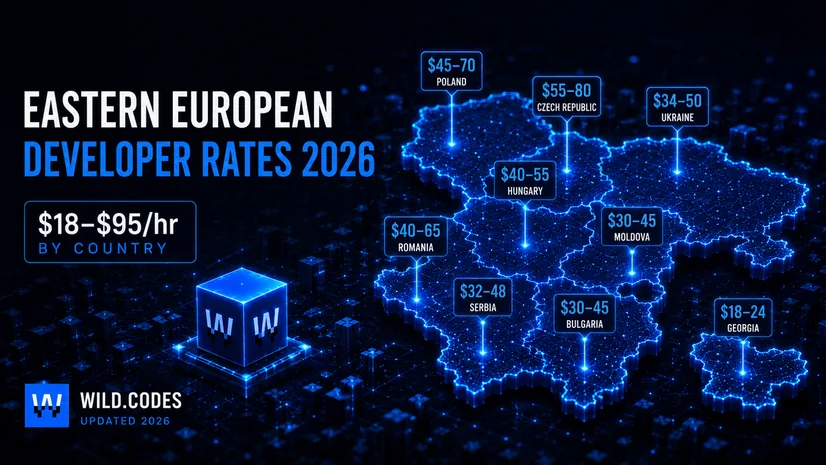
| Pricing | $22–30/hr junior · $30–45/hr mid · $45–70/hr senior (AI/ML: up to $95/hr) |
Warsaw
Warsaw ranks 91st globally as a startup hub and hosts over 200 technology companies, from early-stage startups to multinational R&D centers. Microsoft's roughly $700 million investment in an Azure region here made Warsaw the first hyperscale cloud gateway in the CEE bloc, which matters directly if you're hiring for cloud or platform engineering roles. Kraków, meanwhile, remains the country's densest concentration of ICT talent and its strongest deep-tech scene, while Wrocław has built a reputation in HealthTech.
3. Czech Republic
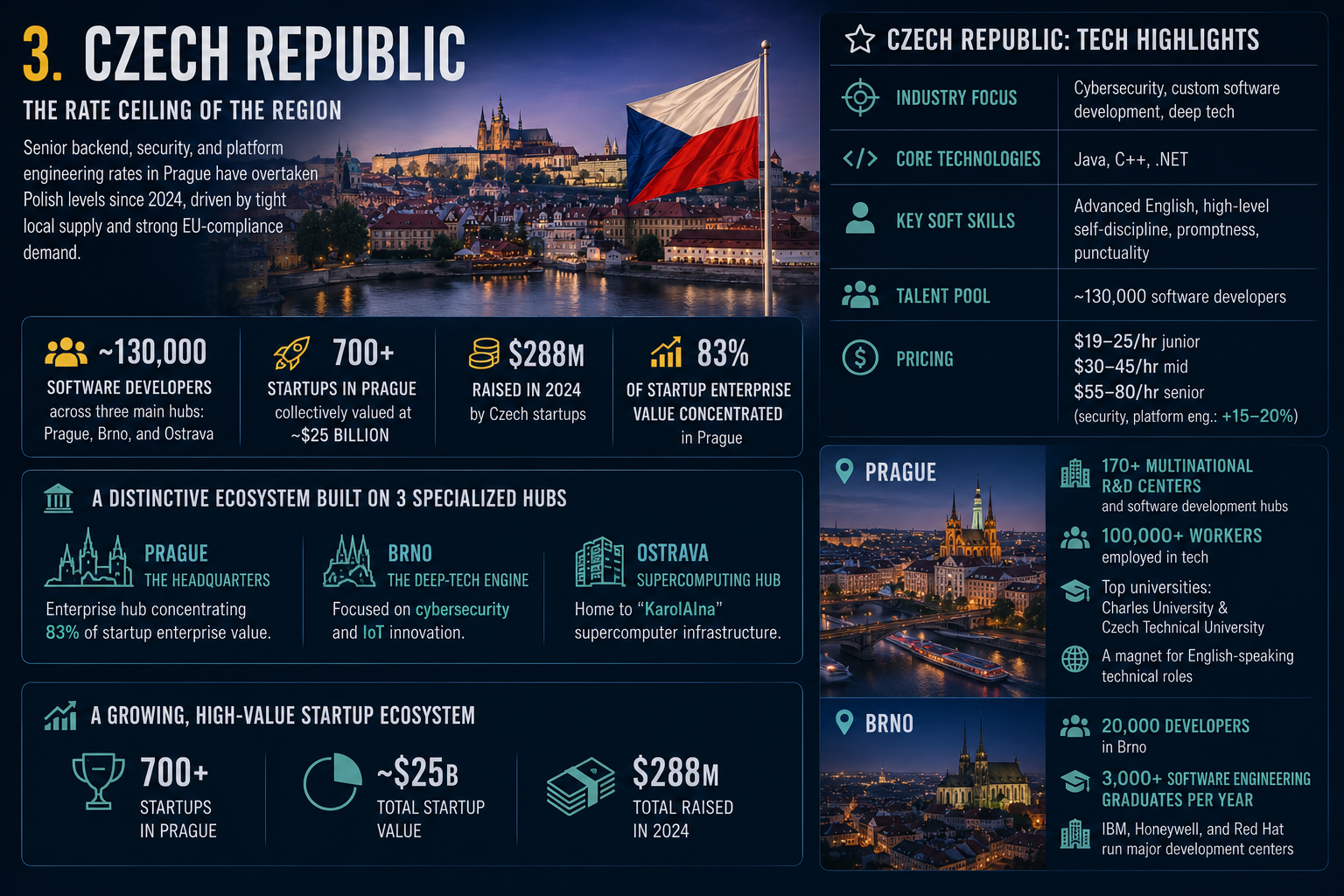
The Czech Republic has quietly become the rate ceiling of the region — senior backend, security, and platform engineering rates in Prague have overtaken Polish levels since 2024, driven by tight local supply and strong EU-compliance demand. The country is home to around 130,000 software developers across three main hubs: Prague, Brno, and Ostrava, making it one of the biggest talent pools in the region despite Czechia's smaller overall population.
More than 700 startups now operate in Prague alone, collectively valued at roughly $25 billion, having raised close to $288 million in 2024. The country's specialization is distinctive too: Czechia's tech landscape is anchored by three specialized hubs — Prague as headquarters concentrating 83% of startup enterprise value, Brno as the deep-tech engine focused on cybersecurity and IoT, and Ostrava providing supercomputing infrastructure through its "KarolAIna" system.
Czech Republic: Tech Highlights
| Industry focus | Cybersecurity, custom software development, deep tech |
|---|---|
| Core technologies | Java, C++, .NET |
| Key soft skills | Advanced English, high-level self-discipline, promptness, punctuality |
| Talent pool | ~130,000 software developers |
| Pricing | $19–25/hr junior · $30–45/hr mid · $55–80/hr senior (security, platform engineering: +15–20%) |
Prague
Prague hosts more than 170 multinational R&D centers and software development hubs employing over 100,000 workers, alongside a growing base of homegrown cybersecurity and product companies. Graduates from Charles University and Czech Technical University keep feeding the pipeline, and the city has become a magnet for English-speaking technical roles. Brno, the country's second pole, punches well above its size — the city is home to 20,000 developers and over 3,000 software engineering graduates a year, with IBM, Honeywell, and Red Hat all running major development centers there.
4. Romania
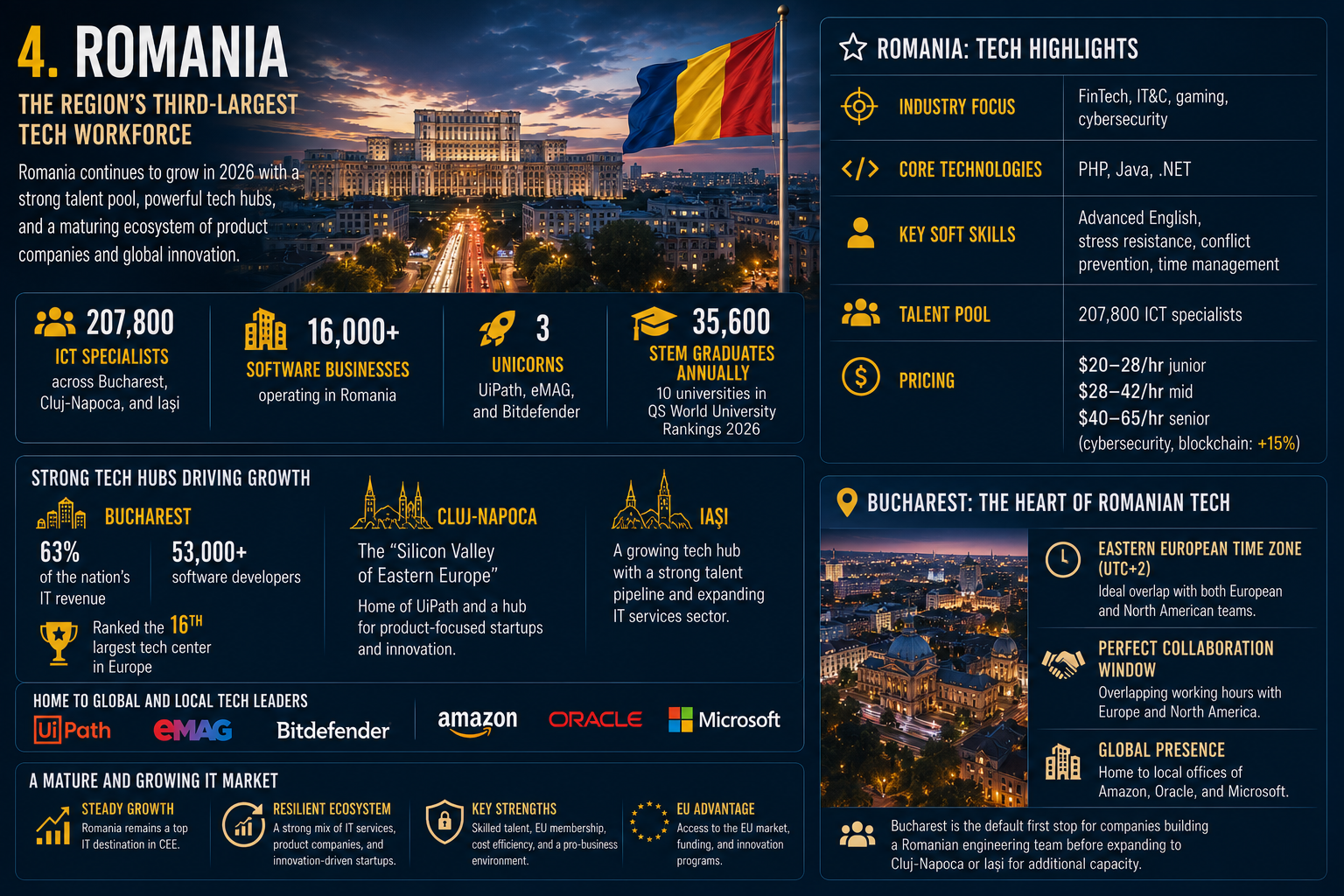
Romania has held its position as the region's third-largest tech workforce after Poland and Ukraine, and 2026 data shows it's still growing. The country is home to 207,800 ICT specialists spread across Bucharest, Cluj-Napoca, and Iași, with over 16,000 software businesses and 3 unicorns — UiPath, eMAG, and Bitdefender. The STEM pipeline stays strong too: Romania produces approximately 35,600 STEM graduates annually, with ten local universities featured in the QS World University Rankings 2026.
Bucharest alone generates 63% of the nation's IT revenue and is home to over 53,000 software developers, ranked the 16th-largest tech center in Europe. Cluj-Napoca has earned its "Silicon Valley of Eastern Europe" nickname for a reason — it's where UiPath put down roots, and it continues to produce a disproportionate share of Romania's product-focused (rather than outsourcing-focused) startups.
Romania: Tech Highlights
| Industry focus | FinTech, IT&C, gaming, cybersecurity |
|---|---|
| Core technologies | PHP, Java, .NET |
| Key soft skills | Advanced English, stress resistance, conflict prevention, time management |
| Talent pool | 207,800 ICT specialists |
| Pricing | $20–28/hr junior · $28–42/hr mid · $40–65/hr senior (cybersecurity, blockchain: +15%) |
Bucharest
Bucharest sits in the Eastern European Time Zone (UTC+2), creating ideal conditions for collaboration with both European and North American tech companies, with working hours that overlap productively with both. The city hosts local offices for Amazon, Oracle, and Microsoft, and remains the default first stop for companies building a Romanian engineering team before expanding to Cluj-Napoca or Iași for additional capacity.
5. Slovakia
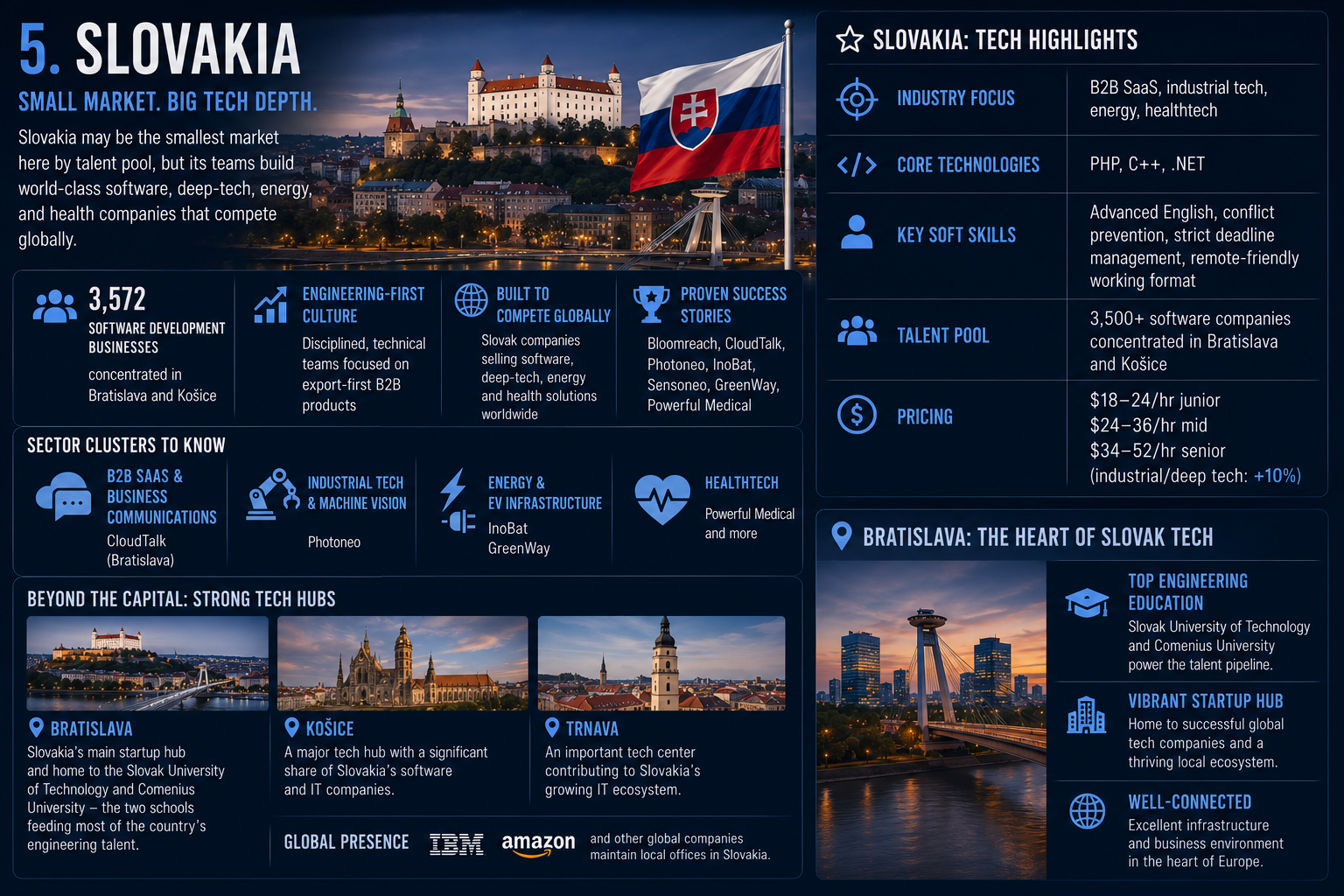
Slovakia is the smallest market on this list by talent pool, but it earns its place through a specific kind of technical depth rather than scale. The country currently counts 3,572 software development businesses, concentrated mainly in Bratislava and Košice. What stands out in 2026 is the caliber of what's coming out of that smaller pool: names like Bloomreach, CloudTalk, Photoneo, InoBat, Sensoneo, GreenWay, and Powerful Medical show that Slovak teams can build software, deep-tech, energy, and health companies that sell internationally.
The sector clusters worth knowing about if you're hiring here: B2B SaaS and business communications (CloudTalk out of Bratislava), industrial tech and machine vision (Photoneo), energy and EV infrastructure (InoBat, GreenWay), and healthtech. It's a market that rewards technical, export-first B2B products more than consumer plays — which tracks with the disciplined, engineering-first culture Slovak teams are known for.
Slovakia: Tech Highlights
| Industry focus | B2B SaaS, industrial tech, energy, healthtech |
|---|---|
| Core technologies | PHP, C++, .NET |
| Key soft skills | Advanced English, conflict prevention, strict deadline management, remote-friendly working format |
| Talent pool | 3,500+ software companies concentrated in Bratislava and Košice |
| Pricing | $18–24/hr junior · $24–36/hr mid · $34–52/hr senior (industrial/deep tech: +10%) |
Bratislava
Bratislava remains Slovakia's main startup hub and home to the Slovak University of Technology and Comenius University — the two schools feeding most of the country's engineering talent. Beyond the capital, Košice and Trnava carry a meaningful share of the country's software and IT companies, with global names like IBM, Amazon, and Dell maintaining local offices.
How These 5 Hubs Compare
| Country | Talent Pool | Senior Rate ($/hr) | Strongest For |
|---|---|---|---|
| Ukraine | 300,000+ | 34–50 | AI/ML, DefenseTech, FinTech, product engineering |
| Poland | 300,000+ developers (650,000 IT pros) | 45–70 | Enterprise engineering, AI/ML, cloud/DevOps |
| Czech Republic | 130,000 | 55–80 | Cybersecurity, platform engineering, deep tech |
| Romania | 207,800 | 40–65 | FinTech, cybersecurity, blockchain |
| Slovakia | 3,500+ companies | 34–52 | B2B SaaS, industrial tech, energy, healthtech |
A quick honest read across all five: if you need the deepest available bench at competitive rates, Ukraine and Poland still win by scale. If EU-jurisdiction compliance and top-tier security or platform work matter more than headcount, Czech Republic is worth the premium. Romania is the strongest all-around value pick for FinTech specifically, and Slovakia is the one to consider when you need a small, senior, technically excellent team rather than a large one.
For Founders: Picking a Hub Without Overthinking It
If you're choosing between these five countries at 11pm before a fundraising call, here's the shortcut: match the country to what you're actually building, not to whichever blog post you read first. Need to move fast and cheap with real AI depth? Ukraine or Poland. Need EU compliance and security rigor for an enterprise buyer? Czech Republic. Building FinTech and want proven, cost-efficient engineering? Romania. Every week spent debating which country instead of interviewing candidates is a week your roadmap doesn't get back — which is exactly why Wild.Codes builds pre-vetted shortlists across all five of these markets, delivered in 47 hours.
For CTOs: What Actually Changes Between These Markets
The technology stacks overlap more than the marketing suggests — Java, .NET, and Python show up as core technologies in nearly every country on this list. What actually differs is specialization and compliance posture: Czech Republic's security-first culture, Ukraine's AI/ML and DefenseTech depth, Romania's FinTech maturity, Poland's enterprise-scale engineering, and Slovakia's industrial/deep-tech focus. The practical takeaway: don't pick a country because it's cheapest — pick it because its dominant industry cluster matches the problem you're solving, then use a vetted platform to keep the search from turning into a multi-country recruiting project of its own.
Frequently Asked Questions
Which Eastern European country has the largest developer talent pool in 2026?Poland, with roughly 600,000–650,000 IT professionals and over 300,000 concentrated software developers — the largest pool in Central and Eastern Europe. Ukraine follows closely with over 300,000 tech specialists.
Which country is best for hiring AI/ML engineers?Ukraine and Poland currently lead, with the deepest concentration of AI/ML and LLM-tooling specialists in the region and the widest specialist rate premiums (20–40% over generalist senior rates).
Is Ukraine still a safe and reliable place to hire developers in 2026?Yes — Ukraine's IT sector has remained one of the most stable parts of its economy throughout the war, with the tech workforce continuing to grow and IT export revenue climbing year over year. Most Ukrainian teams work remotely by default, which further reduces operational risk for hiring companies.
What's the fastest-growing tech hub on this list?Slovakia and Romania show the sharpest relative momentum for 2026, driven by AI-enabled B2B software and a wave of internationally competitive startups, though both remain smaller in absolute talent-pool size than Poland or Ukraine.
Ready to Hire from Eastern Europe's Top Tech Hubs?
Wild.Codes connects you with AI-vetted developers across Ukraine, Poland, Czech Republic, Romania, Slovakia, and 4 more Eastern European countries — matched in under 47 hours, with a flat subscription rate, payroll and compliance handled, and a free replacement guarantee if the fit isn't right.
- Hire Eastern European Developers → — Browse pre-vetted talent across all 5 hubs in this guide
- Hire AI Specialists → — Senior AI/ML engineers from Ukraine and Poland's deepest talent pools
- Hire Cybersecurity Teams → — Security engineers from the Czech Republic and Romania
- Use the Team Cost Calculator → — Get an instant estimate for your team composition
Conclusion
Eastern Europe's tech map didn't get simpler in 2026 — it got more specialized. Ukraine and Poland still offer the deepest benches, Czech Republic has quietly become the region's rate ceiling for security and platform work, Romania keeps compounding its FinTech reputation, and Slovakia proves that a smaller market can still produce internationally competitive product companies. Whichever hub fits your project, the fastest way from "which country" to "hired" is a platform that's already done the vetting across all five.

• PHP expertise;
• Database management skills;
•Jungling traits, methods, objects, and classes;
• Agile & Waterfall understanding and use;
• Soft skills (a good team player, high-level communication, excellent problem-solving background, and many more)
• OOP & MVS deep understanding;
• Knowledge of the mechanism of how to manage project frameworks;
• Understanding of the business logic the project meets;
• Cloud computing & APIs expertise.
• Reasonable life-work balance;
• The opportunity to implement the server-side logic via Laravel algorithms;
• Hassle-free interaction with back-end and front-end devs;
• Strong debugging profile.
• Using HTML, XHTML, SGML, and similar markup languages
• Improving the usability of the digital product
• Prototyping & collaboration with back-end JS experts
• Delivery of high-standard graphics and graphic-related solutions
• Using JS frameworks (AngularJS, VueJS, ReactJS, etc
• Clean coding delivery and timely debugging & troubleshooting solution delivery
• UI testing and collaboration with front-end JS teammates
• Database experience
• Building APIs while using REST or similar tech solutions
• Collaboration with project managers and other devs
• Delivery of design architecture solutions
• Creation of designs & databases
• Implementation of data protection and web cybersecurity strategies.
• Both front-end and back-end qualifications