





HERE’S WHY HIRING SLOWS YOU DOWN

You pay salary. You wait months. Nothing moves. Your burn keeps running. Your product stays behind.

Your roadmap is clear. But you don’t have the people to build it. Everything depends on hiring. And hiring keeps failing.

Wrong engineers slow everything down. Fixing mistakes takes even longer. You lose time you don’t have.
YOUR NEXT ENGINEER IN 47 HOURS
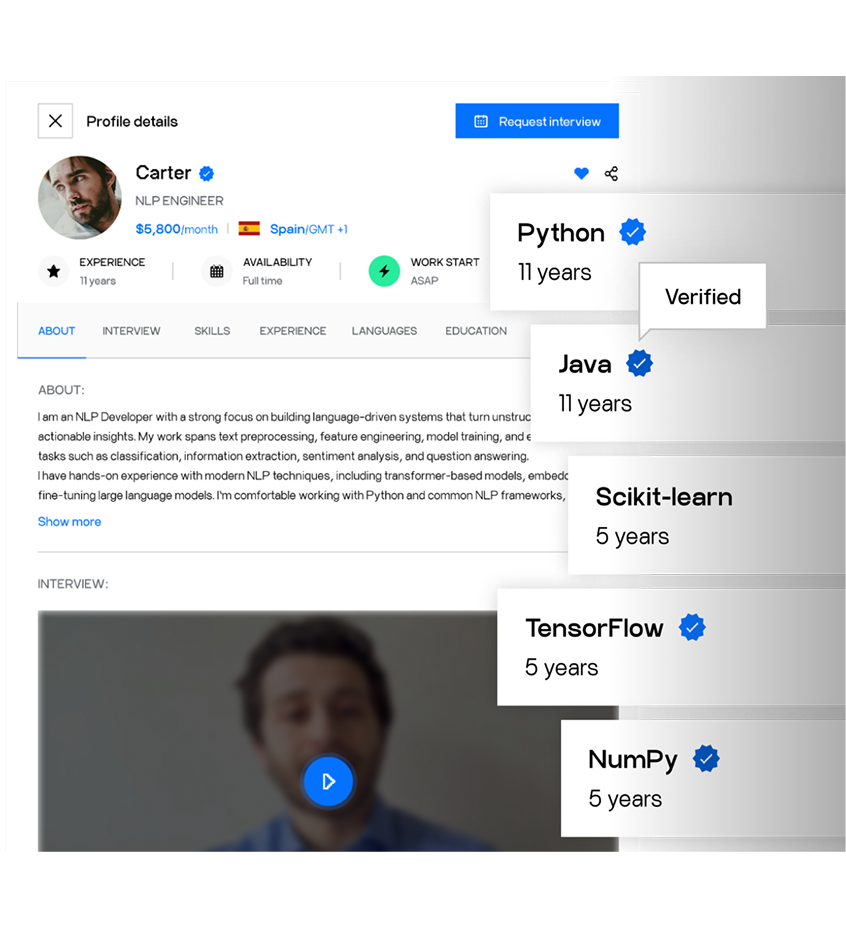
Move as fast as your product and market demand. We deliver engineers ready for your stack and stage.

No CV spam
No unqualified candidates
No screening burden on your team
PRE-VETTED ENGINEERS ONLY
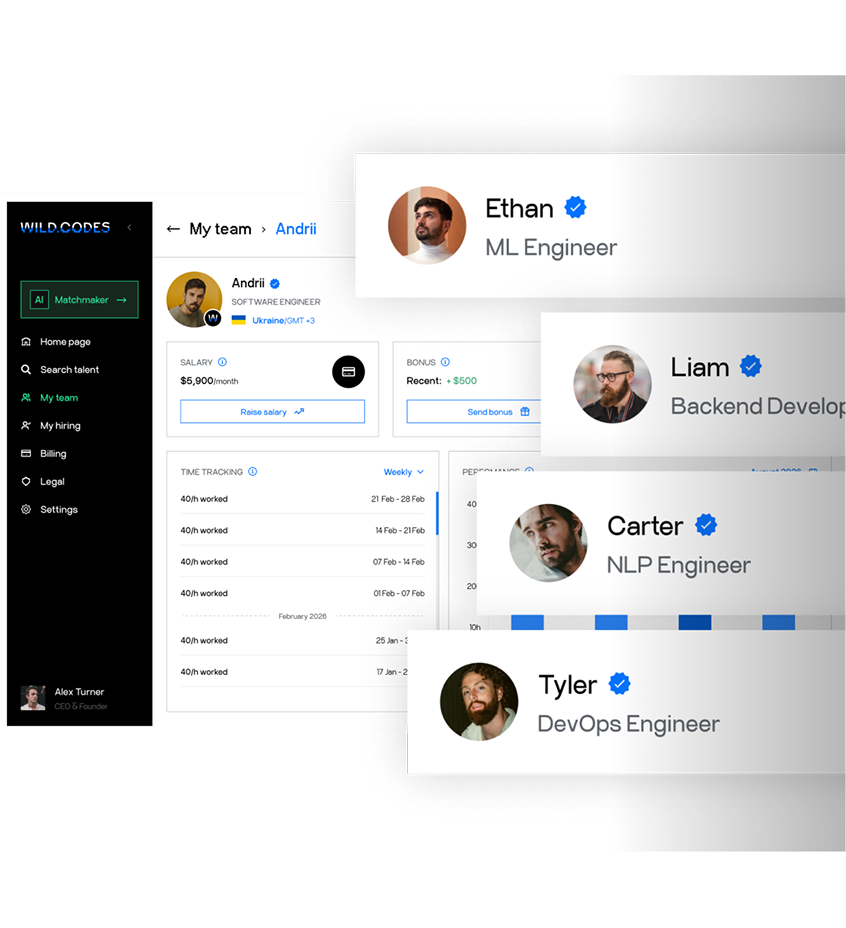
We filter thousands of engineers before you see them. You only meet candidates who passed real technical vetting.
No bad hires
No wasted salaries
No rebuilding your team again
SCALE YOUR TEAM UP OR DOWN ANYTIME
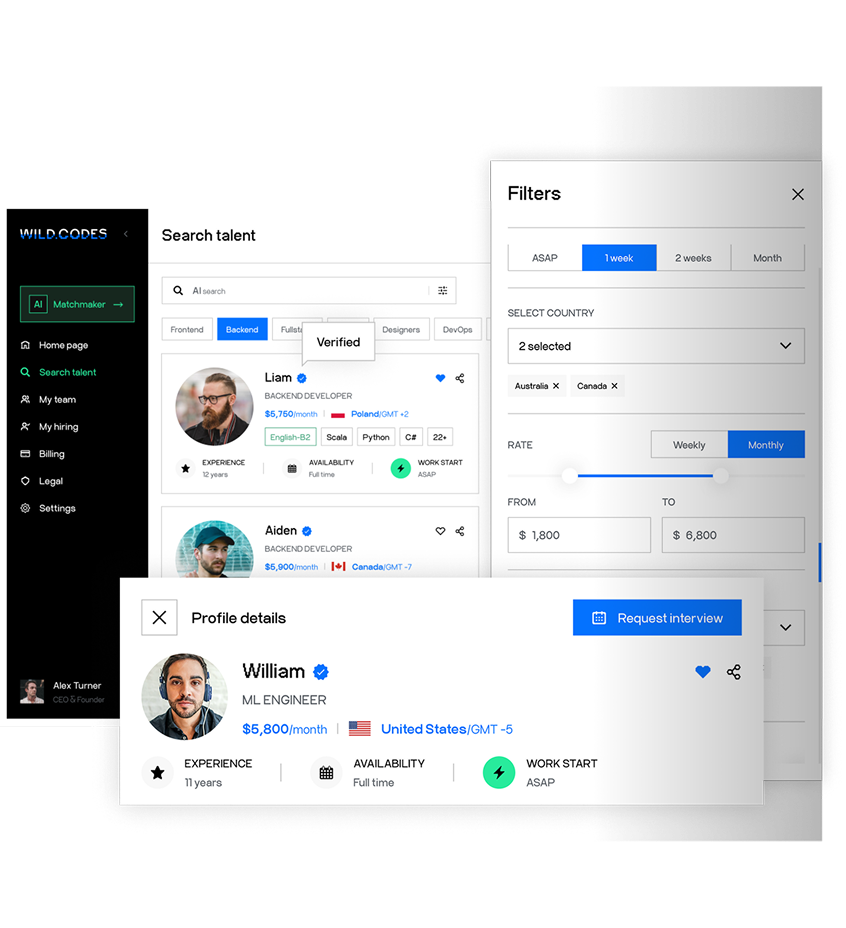
Your team adapts to your company stage and roadmap. Add or replace engineers as your priorities change.
No overhiring risk
No rigid team structure
No scaling limitations
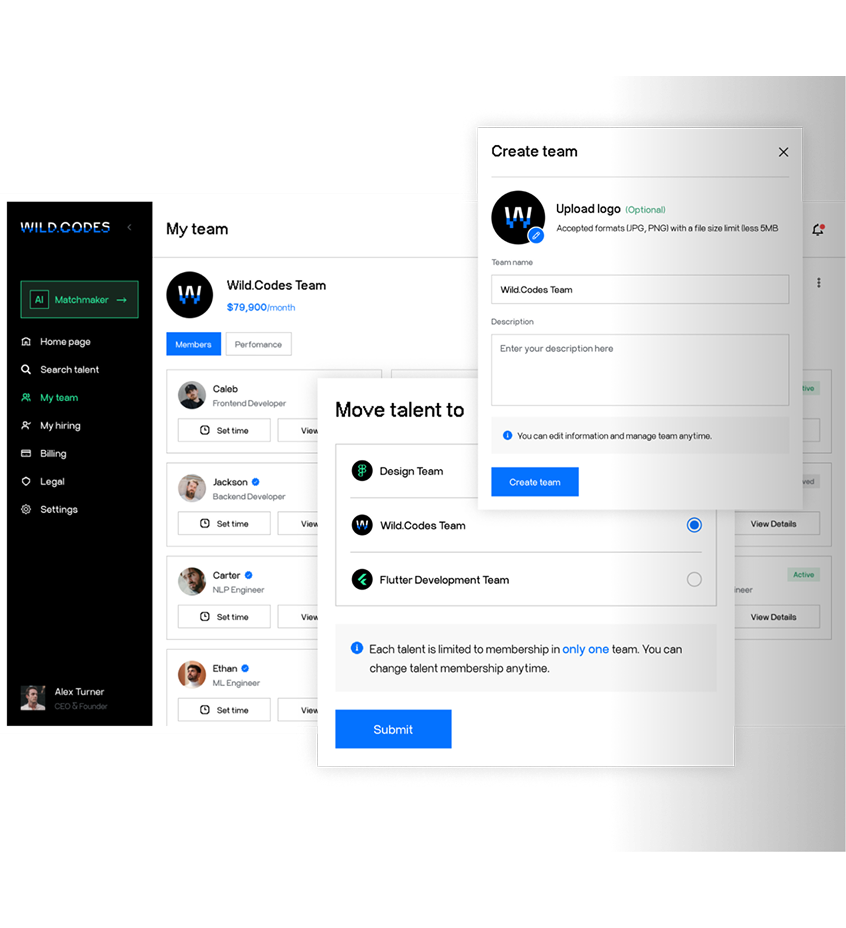
GLOBAL ENGINEERS, READY FOR YOUR STAGE
Access engineers who already worked with startups and scaleups. They understand speed, ownership, and uncertainty.
No corporate-only mindset
No long ramp-up
No founder babysitting
Get Started in 3 Steps
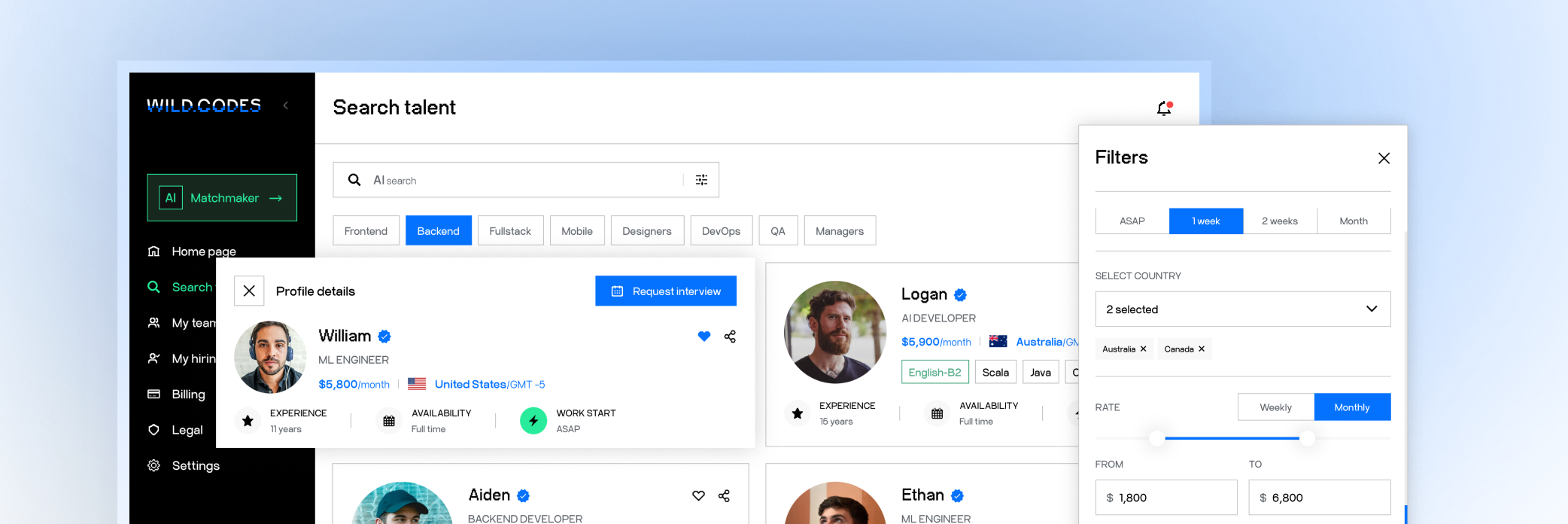

SHARE REQUIREMENTS
Tell us your stack and role.
We handle the rest.

REVIEW ENGINEERS
We send matching engineers.
You choose who fits best.

ENGINEERS JOIN
YOUR TEAM
Engineers integrate into your workflows.





CLIENT STORIES AND EXPERIENCES
As CTO, I had no time for long recruitment. Wild.Codes set up workflows and quickly connected us with top engineering talent when we needed it most.
Working with Wild.Codes saved us time and brought real quality. Fast access to skilled, reliable devs we can trust.
Wild.Codes consistently delivers top devs fast. Great skills, smooth communication, and total peace of mind.
Wild.Codes provided highly skilled developers who delivered exceptional work with precision. Their expertise, clear communication, and accurate estimates ensured success.
STOP LOSING TIME ON HIRING

Discover more

Hire Developers
Ship faster with pre-vetted senior developers matched to your stack, roadmap, and team rhythm — without weeks of sourcing or recruiter loops.

Hire Designers
Bring in product-minded designers who can sharpen UX, clean up flows, and turn messy ideas into interfaces your users actually understand.

Hire Marketers
Add marketing talent that can turn launches, campaigns, and growth experiments into traction — not another backlog of “nice-to-have” ideas.
FAQ
How Founders Build Engineering Teams Without Slowing Their Company Down
Most founders don’t expect hiring to become one of their biggest problems.
At the beginning, it feels manageable. You hire the first engineer. Then another. You interview candidates yourself. You stay close to the process because the company is still small, the product is still changing, and every person who joins has an outsized impact.
For a while, that works.
Then the company starts moving faster. The roadmap expands. Customers ask for more. Bugs matter more. Sales needs product commitments. Investors want evidence that the team can execute. Suddenly, engineering capacity is not a background problem. It is the thing deciding how fast the company can grow.
And hiring does not move at the speed your company moves.
That is the founder trap: you need more engineers to keep momentum, but the process of finding them starts consuming the same time, attention, and decision-making energy you need for product, customers, fundraising, hiring leadership, and everything else.
Building an engineering team for a startup is not just about adding headcount. It is about adding the right people without slowing down the company you are trying to scale.
Hiring Quietly Starts Competing With Everything Else You Need to Do
Hiring rarely breaks the company loudly.
It starts quietly.
A candidate needs one more call. A role needs to be rewritten. A recruiter sends profiles that look fine but do not match the actual work. A promising engineer disappears. A technical interview has to be rescheduled. Someone asks whether this candidate is “good enough for now.”
None of those moments look catastrophic alone. Together, they become a second operating system running inside your company.
Founders feel it first in their calendar. Then in their focus.
You are supposed to be talking to customers, tightening positioning, making product calls, or preparing the next fundraise. Instead, you are reading CVs at night, taking intro calls, and deciding whether slow hiring is worse than risky hiring.
That tradeoff is brutal because both options are expensive.
If you wait too long, the roadmap slips. Your strongest engineers carry more work than they should. Product bets take longer to validate. Customers wait.
If you rush, you risk hiring someone who creates more work than they remove. A weak engineer does not just underperform. They pull attention from founders, tech leads, and the team around them. They add review burden. They create rework. They slow decisions because people stop trusting the output.
This is why “just hire faster” is bad advice. The real goal is not speed alone. The goal is signal.
You need a way to see engineers who are already filtered for ability, ownership, and fit for your stage. Not a bigger pile of profiles. Not more interviews. Not another hiring workflow that still depends on you doing the hard screening.
That is the difference between hiring as a founder bottleneck and hiring as a growth lever.
The Real Risk Isn’t Hiring Slow. It’s Losing Momentum
Slow hiring hurts. But lost momentum is worse.
Momentum is the invisible asset founders protect every day. It shows up when the team ships faster than competitors expect, customers stay engaged, and investor updates show motion instead of explanations.
Hiring problems attack that momentum from multiple directions.
First, they delay output. If you need backend capacity, frontend support, DevOps help, or AI engineering skill and cannot add it fast enough, the work does not magically disappear. It gets delayed, reduced, or pushed onto people who are already stretched.
Second, they weaken decision quality. When a role stays open for too long, the standard starts moving. Founders begin asking dangerous questions: “Can we make this candidate work?” “Can we train them up?” “Can the team absorb the risk?” Sometimes the answer is yes. Often, it is a sign the company is negotiating with pressure instead of choosing from strength.
Third, hiring drag changes how the team behaves. Engineers become careful about commitments. Product becomes cautious about scope. Founders start sequencing growth around capacity gaps instead of market opportunity.
That is the expensive part.
The company does not only lose the time spent hiring. It loses the compounding effect of moving quickly while the market window is open.
For founders, the best hiring system is not the one that looks most complete on paper. It is the one that protects momentum. It gives you qualified engineers quickly enough to keep building, without forcing you to lower the bar or turn hiring into your full-time job.
Wild.Codes is built around that idea. Instead of sending volume, we filter first. You see engineers who passed real technical vetting and are matched to the work you actually need. If you want to see how the matching flow works, start with the find your perfect match path.
Why Hiring Is Especially Hard for Founders
Hiring is hard for every company. It is harder for founders because the margin for error is smaller.
A large company can absorb a slow hire. A founder often cannot. When your team is small, one wrong engineer changes velocity, morale, and cash efficiency. One delayed hire can block a launch. One weak hiring decision can pull your best people into rescue mode.
Founders also hire under uncertainty.
You may not have a perfectly stable roadmap. The role may evolve in two months. The person joining may need to work across product, infrastructure, customer feedback, and messy edge cases. You are not hiring someone to sit inside a narrow corporate process. You are hiring someone who can create progress while the company is still changing.
That requires a different kind of signal.
CVs do not show whether someone can handle ambiguity. Marketplaces do not prove ownership. Recruiter intros do not tell you whether an engineer can join a startup workflow and start contributing without constant hand-holding.
Founders need engineers who can do three things at once:
- deliver the technical work;
- understand the speed and ambiguity of a startup;
- reduce pressure on the core team instead of adding more coordination burden.
That is why generic hiring pipelines often fail at the founder stage. They are designed to create candidate flow, not certainty. You get more options, but not necessarily better decisions.
The better question is not “How do we get more candidates?”
It is “How do we get to the right few candidates faster?”
That shift matters. CTOs and engineering leaders feel the same pressure from a delivery-risk angle, which is why the same problem shows up on the CTO and tech leaders page. Engineering managers feel it inside team velocity and overload, which is covered on the engineering managers page. For founders, the pain is broader: every hiring delay competes with company momentum.
What Changes When Hiring Stops Slowing You Down
When hiring stops slowing you down, the company feels different.
You stop planning around gaps. You stop treating every new role like a founder-level project. You stop accepting weak candidate signal because the company is under pressure. The team can make commitments with more confidence because capacity is not a mystery that might be solved “next month.”
The founder’s role changes too.
You still make the important calls. You still decide who fits the company. You still protect the bar. But you are no longer doing the heavy lifting that should happen before candidates reach you: sourcing, filtering, technical vetting, and separating real ability from polished presentation.
That creates leverage.
Instead of spending hours reviewing profiles that should never have reached you, you review a focused shortlist. Instead of restarting from zero when someone is not a fit, you can replace quickly. Instead of hiring ahead of the business and carrying unnecessary risk, you can scale the team up or down as priorities change.
This is especially useful because the company stage keeps shifting. The engineering team you need before product-market fit may not be the same team you need after a growth push. A new customer, AI feature, or infrastructure rebuild can change the capacity plan fast.
Rigid hiring does not handle that well. Flexible access to vetted engineers does.
The outcome is simple: your company keeps moving.
You get engineers who can join fast, work in your stack, and contribute without turning onboarding into another founder bottleneck. Your internal team gets support before overload becomes normal. Your roadmap becomes less dependent on whether the hiring market cooperates this month.
That is how founders build engineering teams without slowing the company down: not by doing more hiring work, but by removing the parts of hiring that create drag.
If hiring is already competing with product, customers, or growth, do not wait until the team is fully stretched. Book a call or start hiring with Wild.Codes, and get the right engineers into the work before momentum slips.
Table of Contents