How to Judge a Recorded Technical Interview

Published 25 November 2026
A recorded technical interview shows how an engineer reasons about a problem like yours and explains work they have shipped, all against a time limit, before you spend a call on them. It does not show live debugging, pairing or how they take feedback. Judge it the way you would judge a structured interview: the same questions for every candidate, a scoring guide written before you press play, and a score for each answer.
Wild.Codes wrote this guide. We run timed recorded interviews in our own product, so we have a stake in the format. The research and the law below come from the sources we link, and our own numbers sit in one section, with dates.
Key takeaways
- Structure is what the research backs. A 2022 re-analysis ranked structured interviews first among selection procedures, while the recorded format itself is still under-studied.
- A recording decides who earns your live interview time. Keep your own interview for what a recording cannot show.
- Write the scorecard before you watch. Read the transcript first, then score each answer on its own.
- Score what the candidate said. HireVue said in 2021 that non-verbal data added no significant predictive power over language.
- If software scores the videos, Illinois, New York City and the EU AI Act each put duties on the employer.
Contents
- What is a recorded technical interview?
- What does a recording show?
- What can't it show?
- How do you score one?
- Why does it matter now?
- Is AI scoring legal?
- How we use recordings
- FAQ
- How we put this together
What is a recorded technical interview?
It is a set of preset technical questions that the candidate answers on camera, with no interviewer on the call. You will also see it called a one-way video interview or a recorded video interview. A 2020 review in Human Resource Management Review describes these as "a form of one-way, technology-mediated, selection interviewing" and adds that the method "varies substantially in design and execution". For the wider family of written and recorded first rounds, see our glossary entry on async developer screening.
The University of Illinois career center describes the usual mechanics. The hiring side writes the questions and "sets a time limit for the response, i.e. one minute, two minutes, etc." Every candidate for the role gets the same questions in the same order, with the same time to prepare and answer. Some formats allow a re-record, others allow one attempt.
| Format | Who is on the call | What it shows best | What it misses |
|---|---|---|---|
| Recorded technical interview | Nobody. The candidate answers preset questions alone | How they frame a problem and explain past work under a clock | Back-and-forth, live coding, follow-up questions |
| Live technical interview | Your engineer and the candidate | Follow-ups, debugging together, how they take a hint | Consistency across candidates, unless you run it from a script |
| Take-home task | Nobody | Code they write with time to think | Who wrote it and how long it took |
What does a recording show?
A good recorded question for an engineer asks about a situation from your own work: a slow endpoint, a migration, an incident, a design choice your team argued about. Two minutes on that is enough to hear how someone thinks. Listen for these signals.
| Signal | What to listen for | Red flag |
|---|---|---|
| Problem framing | They restate the problem, name their assumptions and ask what they would need to know | They jump straight to a tool name |
| Trade-offs | Two options, what each costs, and why they would pick one for your case | One "best practice" with no cost attached |
| Depth on your stack | Specifics from their own work: failure modes, limits they hit, numbers they measured | Textbook definitions that would fit any company |
| Ownership of past work | "I decided", "I got it wrong", with detail on what changed after | Only "we", and nothing they could be asked about |
| Clarity under the clock | A short structure and a conclusion inside the time limit | They run out of time mid-thought, or read an answer off the screen |
The time limit is part of the signal. Explaining a decision to a colleague without notes is part of an engineer's job, and a recording shows how they do it.
What can't it show?
A recording is a monologue. It cannot show how someone debugs with you watching, how they pair, how they react when you push back on a design, or what they ask you. It also tells you little about how they work with your team over months.
Keep those for your own interview. Our list of interview questions for CTOs hiring remote engineers covers that live round.
A recording is not an identity check either. Our guide on how to hire remote developers sets out identity checks at the interview, at onboarding and after the start date.
How do you score one?
Start with what the research supports. In a 2022 re-analysis of selection research in the Journal of Applied Psychology, Sackett, Zhang, Berry and Lievens (doi:10.1037/apl0000994) found that "Structured interviews emerged as the top-ranked selection procedure." The same paper found that most methods kept their rank "but with mean validity estimates reduced by .10-.20 points". No method is a crystal ball, and structure is the part that holds up.
The US Office of Personnel Management defines a structured interview with two rules. "All candidates are asked the same predetermined questions in the same order", and every answer is rated on the same scale with the same standards for an acceptable answer.
The recorded format itself has much less evidence behind it. The 2020 review found that "research on AVIs is lagging far behind practice. Empirical evidence is scarce". So a recording is worth as much as the structure you put around it.
A scorecard you can copy, scored 1 to 4 per answer:
| Criterion | Strong (4) | Weak (1) |
|---|---|---|
| Problem framing | Restates the problem in their own words and names what they would check first | Answers a different, easier question |
| Trade-offs named | Two or more options, with cost and risk for each | One answer presented as the only one |
| Depth on the named stack | Specific limits, failure modes or measurements from real work | Generic definitions |
| Ownership of past work | Their own decisions and mistakes, with detail | "We did it", no personal role |
| Clarity under the clock | A structure and a conclusion inside the limit | No conclusion, or a scripted read |
How to run it:
- Write the questions for the role and the scorecard before anyone records an answer.
- Read the transcript first and score the content. Then watch the video for anything the text misses, such as a long pause before a hard question.
- Score each answer on its own, and write one line of evidence next to each score.
- Have a second engineer score the borderline candidates without seeing the first scores.
- Leave out accent, lighting, background and camera manner. They are not the job.
Why does it matter now?
CVs and applications carry less signal than they did. A Gartner survey of 3,290 job candidates in late 2024 found that 39% used AI during the application process. In a second Gartner survey of 3,000 candidates in mid-2025, 6% admitted to interview fraud: posing as someone else, or having someone else pose as them. "It’s getting harder for employers to evaluate candidates’ true abilities, and in some cases, their identities," said Jamie Kohn, a senior research director at Gartner.
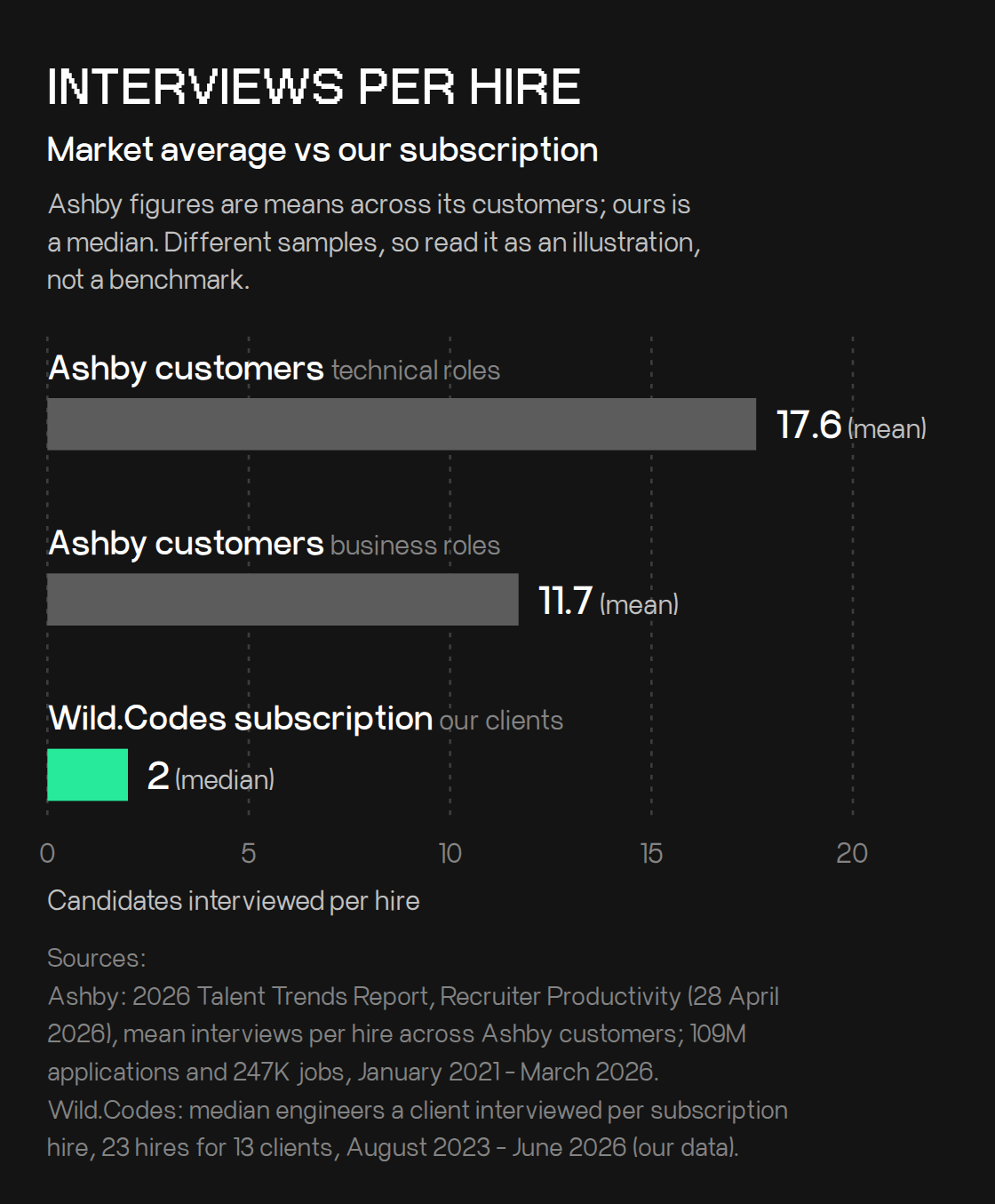
Interview time is also stretched. The Ashby 2026 Talent Trends Report, built on over 109M applications and 247K jobs from January 2021 to March 2026, found that technical roles average 17.6 interviews per hire, 52% more than in 2021. By Q1 2026 a technical hire took 23.3 hours of total interview time, against 12.2 hours for a business hire. In 2021 about 7-8% of applications led to an interview, and the report now puts it at 3.6% to 4.7%.
A timed answer to a question about your own system is harder to prepare in advance than a CV. It does not prove identity on its own, but it gives you something real to judge before your team spends an hour. Our piece on developer CVs that say nothing covers the CV side of this problem.
Is AI scoring legal?
Watching a recording yourself raises few new questions. Letting software score it does. Three rule sets matter for most teams hiring engineers. This is a summary of public texts, not legal advice.
| Where | When it applies | What the employer must do |
|---|---|---|
| Illinois Artificial Intelligence Video Interview Act (820 ILCS 42) | AI analysis of recorded interviews for positions based in Illinois | Tell the applicant before the interview, explain how the AI works and what it evaluates, and get consent. Share videos only with people needed to evaluate the applicant. On request, delete them within 30 days, including copies others hold. If AI alone decides who gets an in-person interview, report race and ethnicity data every year. |
| New York City Local Law 144 | An automated tool used for jobs in the city, which the regulator says includes screening and fully remote jobs tied to an NYC office | An independent bias audit before use, repeated every year, with a published summary. Notice to candidates who live in the city 10 business days before the tool is used. The duty sits with the employer: "The vendor that created the AEDT is not responsible for a bias audit of the tool." |
| EU AI Act, Annex III point 4(a) | AI used "to analyse and filter job applications, and to evaluate candidates" is a high-risk use | Under Article 26(2) the employer must assign human oversight to people with the competence, training and authority to do it. The Annex III rules apply from 2 December 2027, per the Commission timeline as of November 2026. |
One vendor's own data points the same way as the scorecard above. In January 2021 HireVue wrote that its "algorithms do not see significant additional predictive power when non-verbal data is added to language data", and that it would "not use any visual analysis in our pre-hire algorithms going forward." That is the vendor's own research. In SHRM's coverage, AI ethics lecturer Merve Hickok put it more bluntly: "Facial analysis has never been an independently and scientifically validated predictor of a person's ability, capacity or success in a role".
If a tool you buy scores faces, tone or delivery, ask the vendor what it measures and how it was tested. Under the New York City rule, the audit duty stays with you.
How we use recordings
This section is about our own product, so read it as first-hand evidence from an interested party.
In the full search, engineers take a timed video interview for your role. AI writes the questions, each gives a minute to think, then the camera starts. The answers get AI and human review, and you watch them before your own interview. On shortlisted profiles that carry a recording, you see the video and a transcript for each answer. Our vetting process page describes the full sequence.
We held 106 recorded AI interviews from April to September 2026. Measured on 30 September 2026, 55 of 64 client-visible shortlist rows on past client roles carried a video (86%).
Software does not pick the engineer. A talent manager confirms or corrects the AI's assessment of each shortlisted candidate and signs off the shortlist, and the client decides whom to hire. Each AI score is stored with the name of the model and the version of the prompt that produced it, and our Head of Talent marks where the scores are right or wrong.
On our subscription, clients interviewed a median of 2 of our engineers per hire (23 hires for 13 clients, August 2023 to June 2026). Ashby's figure for technical roles is a mean of 17.6. The samples and the measures differ, so the chart below is an illustration and makes no claim about cause.
Hiring an engineer? Describe the role and see your matches. Confirm the role to start the full search, where engineers take a timed video interview for it that you can watch before your own. No cost until you hire.
FAQ
What is a one-way video interview?
It is an interview where the candidate records answers to preset questions with no interviewer on the call. The employer sets the questions and a time limit per answer, and reviews the recordings later.
Are recorded video interviews reliable for hiring engineers?
The format has little research behind it: a 2020 review found that research on these interviews lags far behind practice. What the research does back is structure. A 2022 re-analysis ranked structured interviews first among selection procedures, so a recording is as reliable as its questions and scoring guide.
What should a recorded technical interview include?
Questions written for the role, the same for every candidate, a short time to think before each answer, a time limit, a transcript next to the video, and a scorecard written before anyone watches.
Can a recording replace the technical interview?
No. It shows reasoning and communication against a clock, but not live debugging, pairing or how someone takes feedback. Use it to decide who earns your live interview, then use that interview for what the recording cannot show.
Is it legal to use AI to score video interviews?
It depends on where the job and the candidate are. Illinois requires notice, an explanation and consent before AI analysis of recorded interviews. New York City requires a yearly independent bias audit and advance notice for automated screening tools, and the EU AI Act treats AI that evaluates candidates as high-risk. Check with counsel for your case.
How long should each answer be?
The employer sets it. The University of Illinois career center gives one minute or two minutes as examples, and we found no measured average across platforms. Pick a limit that fits the question and keep it the same for every candidate.
How we put this together
Wild.Codes wrote this article in November 2026. We read the research on structured and asynchronous video interviews, the public texts of the Illinois act, the New York City rule and the EU AI Act, and survey and dataset reports from Gartner and Ashby. Every external fact links to the page we opened. The numbers about our own product come from our records, with the measurement dates given next to them.
Sources
- Sackett, Zhang, Berry, Lievens, Journal of Applied Psychology, 2022: doi.org/10.1037/apl0000994 (abstract also on PubMed, PMID 34968080)
- Lukacik, Bourdage, Roulin, "Into the void: A conceptual model and research agenda for the design and use of asynchronous video interviews", Human Resource Management Review, 2020: doi.org/10.1016/j.hrmr.2020.100789
- US Office of Personnel Management, Structured Interviews: opm.gov
- University of Illinois Career Center, Pre-recorded interviews: careercenter.illinois.edu
- Illinois Artificial Intelligence Video Interview Act, 820 ILCS 42: ilga.gov
- NYC Department of Consumer and Worker Protection, Automated Employment Decision Tools FAQ, 29 June 2023: nyc.gov
- EU AI Act, Annex III: AI Act Service Desk
- EU AI Act, Article 26: AI Act Service Desk
- European Commission, AI Act implementation timeline: AI Act Service Desk
- HireVue blog post on audit results and visual analysis, 12 January 2021: hirevue.com
- SHRM news report on HireVue and facial analysis, 3 February 2021: shrm.org
- Ashby, 2026 Talent Trends Report: Recruiter Productivity, 28 April 2026: ashbyhq.com
- Gartner press release, 31 July 2025: gartner.com

• PHP expertise;
• Database management skills;
•Jungling traits, methods, objects, and classes;
• Agile & Waterfall understanding and use;
• Soft skills (a good team player, high-level communication, excellent problem-solving background, and many more)
• OOP & MVS deep understanding;
• Knowledge of the mechanism of how to manage project frameworks;
• Understanding of the business logic the project meets;
• Cloud computing & APIs expertise.
• Reasonable life-work balance;
• The opportunity to implement the server-side logic via Laravel algorithms;
• Hassle-free interaction with back-end and front-end devs;
• Strong debugging profile.
• Using HTML, XHTML, SGML, and similar markup languages
• Improving the usability of the digital product
• Prototyping & collaboration with back-end JS experts
• Delivery of high-standard graphics and graphic-related solutions
• Using JS frameworks (AngularJS, VueJS, ReactJS, etc
• Clean coding delivery and timely debugging & troubleshooting solution delivery
• UI testing and collaboration with front-end JS teammates
• Database experience
• Building APIs while using REST or similar tech solutions
• Collaboration with project managers and other devs
• Delivery of design architecture solutions
• Creation of designs & databases
• Implementation of data protection and web cybersecurity strategies.
• Both front-end and back-end qualifications